

Introduction
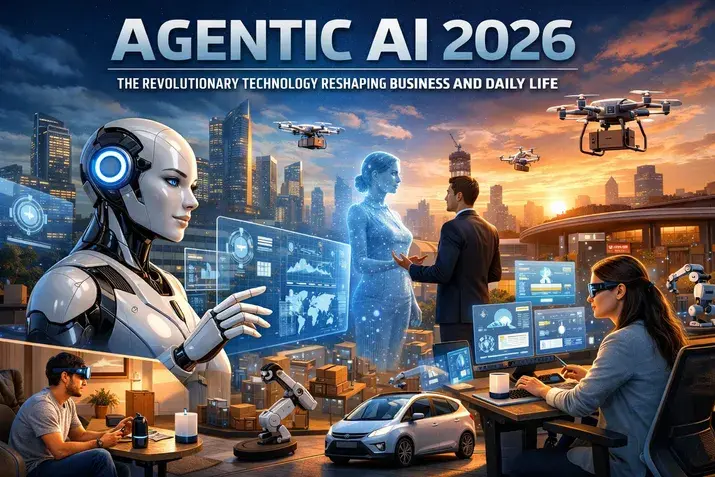
The technological landscape is witnessing a paradigm shift as Agentic AI 2026 emerges as the most transformative innovation since the internet. Unlike traditional artificial intelligence systems that simply respond to commands, agentic AI operates with remarkable autonomy, making independent decisions, learning from experiences, and executing complex tasks without constant human supervision. This revolutionary technology is fundamentally changing how businesses operate, how professionals work, and how everyday consumers interact with digital systems.
As we navigate through 2026, organizations across healthcare, finance, manufacturing, and retail are implementing agentic AI solutions to gain competitive advantages and streamline operations. According to recent research by Gartner, companies adopting Agentic AI 2026 technologies are experiencing productivity increases of up to 40% while simultaneously reducing operational costs by 25%. This isn’t just another technological trend—it’s a fundamental transformation in how intelligent systems collaborate with humans to achieve unprecedented results.
Understanding Agentic AI: Beyond Simple Automation
What Makes Agentic AI Different?
Agentic AI 2026 represents a significant evolution from conventional AI systems. Traditional AI tools require explicit instructions for every task, functioning essentially as sophisticated calculators. Agentic AI, however, possesses goal-oriented autonomy, enabling it to understand objectives, devise strategies, and adapt approaches based on changing circumstances.
The key characteristics include:
- Autonomous decision-making without requiring constant human input
- Adaptive learning that improves performance through experience
- Multi-step reasoning for solving complex, layered problems
- Contextual awareness understanding situational nuances
- Proactive problem-solving identifying and addressing issues before they escalate
Real-World Applications Transforming Industries
In healthcare, agentic AI systems are revolutionizing patient care by monitoring vital signs, predicting potential complications, and automatically adjusting treatment protocols. Mayo Clinic recently implemented an agentic AI solution that reduced diagnostic errors by 35% while freeing physicians to focus on patient interaction rather than administrative tasks.
Financial institutions are deploying Agentic AI 2026 for fraud detection, portfolio management, and customer service. JPMorgan Chase reported that their agentic AI systems processed over 12,000 commercial credit agreements in seconds—work that previously required 360,000 hours of lawyer time annually.
Manufacturing giants like Siemens are using agentic AI to optimize production lines, predict equipment failures, and manage supply chain complexities. Their smart factory in Amberg, Germany, achieves 99.99% quality rates thanks to autonomous AI systems making thousands of micro-adjustments hourly.
Implementation Strategies for Business Success
Getting Started with Agentic AI Integration
Organizations considering Agentic AI 2026 adoption should follow a structured implementation approach:
- Identify high-impact use cases where autonomous decision-making provides maximum value
- Establish clear governance frameworks defining AI decision boundaries and human oversight requirements
- Invest in data infrastructure ensuring quality datasets for AI training
- Develop hybrid workflows combining human expertise with AI capabilities
- Monitor and optimize continuously tracking performance metrics and refining AI behaviors
A comprehensive study from MIT Sloan Management Review revealed that 78% of successful AI implementations began with pilot projects addressing specific pain points rather than organization-wide transformations.
Overcoming Common Implementation Challenges
Organizations face several obstacles when deploying agentic AI systems. Data quality issues top the list, with inconsistent or incomplete datasets undermining AI performance. Companies should establish robust data governance practices before initiating AI projects.
Change management represents another critical challenge. Employees often fear job displacement, creating resistance to new technologies. According to McKinsey research, organizations that invested in reskilling programs alongside AI implementation achieved 2.5 times higher success rates compared to those that didn’t prioritize workforce development.
For deeper insights into how AI agents differ from agentic AI systems and the latest research separating hype from reality, explore this comprehensive analysis of the AI agent boom.
The Future Landscape of Agentic AI
Emerging Trends Shaping 2026 and Beyond
Agentic AI 2026 continues evolving rapidly with several transformative trends gaining momentum:
Multi-agent collaboration is becoming increasingly sophisticated, with multiple AI agents working together to solve complex problems. Research from Stanford University demonstrates that collaborative AI systems outperform single-agent solutions by 60% on complex reasoning tasks.
Ethical AI frameworks are maturing as organizations recognize the importance of responsible AI deployment. The European Union’s AI Act and similar regulations worldwide are establishing guidelines ensuring agentic AI systems operate transparently and fairly.
Edge computing integration allows agentic AI to function locally on devices, reducing latency and enhancing privacy. Apple and Google are embedding agentic capabilities directly into smartphones, enabling real-time personal assistant functions without cloud dependency.
Preparing Your Organization for the AI-Driven Future
Forward-thinking organizations are building AI-ready cultures emphasizing continuous learning and technological adaptability. This includes establishing cross-functional AI teams, creating innovation labs for experimentation, and developing partnerships with AI research institutions.
Investment in AI literacy across all organizational levels has become essential. Companies like Walmart are training thousands of employees on AI fundamentals, ensuring workforce readiness as agentic systems become ubiquitous across business functions.
Frequently Asked Questions
What is the primary difference between traditional AI and Agentic AI 2026?
Traditional AI requires explicit instructions for each task, while agentic AI autonomously sets goals, makes decisions, and adapts strategies without constant human intervention.
How much does implementing Agentic AI cost for small businesses?
Implementation costs vary widely based on use case complexity, ranging from $10,000 for basic automation to $500,000+ for enterprise-scale deployments. Cloud-based solutions offer affordable entry points for smaller organizations.
Will Agentic AI replace human workers?
Rather than replacing workers, agentic AI augments human capabilities, handling repetitive tasks while humans focus on creative problem-solving, relationship building, and strategic thinking.
How can organizations ensure their Agentic AI systems make ethical decisions?
Implementing robust governance frameworks, conducting regular audits, maintaining human oversight for critical decisions, and training AI on diverse, representative datasets helps ensure ethical AI behavior.
What industries benefit most from Agentic AI adoption?
Healthcare, finance, manufacturing, retail, and logistics see particularly strong benefits, though virtually every industry can leverage agentic AI for improved efficiency and decision-making.
Conclusion
Agentic AI 2026 represents more than incremental technological progress—it’s a fundamental reimagining of how intelligent systems collaborate with humans to achieve extraordinary outcomes. Organizations embracing this technology are positioning themselves at the forefront of the digital revolution, gaining competitive advantages through enhanced efficiency, improved decision-making, and unprecedented scalability. The evidence is compelling: companies implementing agentic AI strategically are outperforming competitors, delighting customers, and creating new value propositions previously unimaginable.
The journey toward AI-enabled transformation requires thoughtful planning, strategic investment, and cultural adaptation. However, organizations that successfully navigate this transition will thrive in an increasingly AI-driven economy. As agentic AI capabilities continue expanding, the question isn’t whether to adopt this technology, but how quickly and effectively organizations can integrate it into their operations. The future belongs to those who embrace intelligent automation while maintaining the human elements that drive innovation, empathy, and creativity. Start your agentic AI journey today, and position your organization for success in tomorrow’s intelligent world.
External Resources:
- Gartner’s AI and Machine Learning Research
- MIT Sloan Management Review – AI Implementation Strategies
Social Media Hashtags:
#AgenticAI2026 #ArtificialIntelligence #AITransformation #BusinessInnovation #FutureOfWork #DigitalTransformation #AIAutomation #MachineLearning #TechTrends2026 #EnterpriseAI #AIStrategy #IntelligentAutomation