

Introduction
Artificial intelligence is transforming almost every corner of the digital world—from healthcare and education to entertainment and media. One of the most controversial and fast-growing areas is AI PORN, a topic that raises serious questions about consent, privacy, creativity, and responsibility. While the technology behind it is complex, the real-world impact is deeply human.
As AI tools become easier to access, realistic synthetic images and videos are no longer limited to research labs. They are now part of mainstream online culture, forcing governments, platforms, and users to rethink digital ethics. This article breaks down the issue in simple, engaging language, using real examples, expert insights, and trusted sources to help you understand what’s happening—and why it matters.
What Is AI-Generated Adult Content?
AI-generated adult content refers to media created or altered using machine learning models, such as deep learning and generative adversarial networks (GANs). These systems can:
Generate entirely synthetic adult images
Modify existing photos or videos
Create hyper-realistic deepfakes
Unlike traditional media, these outputs may feature people who never consented—or never existed at all.
How the Technology Works (Simple Explanation)
Data Training: AI models are trained on massive datasets
Pattern Learning: The system learns visual patterns
Content Generation: New images or videos are produced based on prompts
This same technology powers harmless tools like image enhancement and virtual avatars, but misuse has created global concern.
Real-World Impact and Case Studies
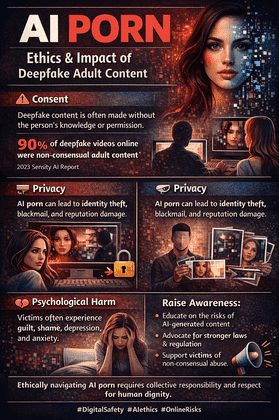
A 2023 report by Sensity AI found that over 90% of deepfake videos online were non-consensual adult content, with women being the primary targets. Public figures and private individuals alike have reported reputational damage, emotional distress, and legal challenges.
Case Example
In 2024, several schools in the U.S. reported incidents where students used AI tools to generate fake explicit images of classmates. These cases led to suspensions, lawsuits, and new state-level legislation addressing synthetic media abuse.
Ethical, Legal, and Social Concerns
The rise of AI PORN has highlighted gaps in existing laws and platform policies.
Key Ethical Issues
Lack of consent
Identity theft and impersonation
Psychological harm
Legal Landscape (Quick Overview)
Some countries classify AI deepfakes as digital fraud
Others are introducing “right to likeness” laws
Enforcement remains inconsistent
According to a Brookings Institution analysis, global regulation is still “reactive rather than preventive,” leaving victims vulnerable.
Faith, Philosophy, and Cultural Perspectives
A thoughtful discussion on moral responsibility can be found in this in-depth article:
👉 AI and the Future of Porn – Biola University
https://www.biola.edu/blogs/think-biblically/2024/ai-and-the-future-of-porn
This perspective emphasizes human dignity, intentionality, and the long-term cultural cost of unchecked technology.
How Platforms and Users Can Respond
Practical Steps for Platforms
AI content labeling
Stronger identity verification
Faster takedown systems
What Users Can Do
Report non-consensual content
Use privacy protection tools
Support ethical AI initiatives
SEO & Accessibility Best Practices (For Publishers)
To ensure ethical and accessible content delivery:
Use clear, sequential headings (H2 → H3)
Maintain high color contrast for readability
Ensure link text is descriptive and screen-reader friendly
Avoid unnecessary scripts to reduce unused CSS/JS
Apply ARIA roles only where compatible
These steps improve usability, trust, and long-term search visibility.
FAQs About AI-Generated Adult Content
Is AI-generated adult content legal?
Laws vary by country. Some regions ban non-consensual synthetic media, while others lack specific regulations.
Can AI content be detected?
Yes. New detection tools analyze pixel patterns and metadata, though accuracy is still improving.
Is all AI adult content harmful?
Not all. Ethical use with consent and transparency exists, but misuse remains a major concern.
How can victims get help?
Victims should document evidence, report to platforms, and seek legal or counseling support.
Conclusion
The conversation around AI PORN is not just about technology—it’s about people, rights, and responsibility. As innovation accelerates, society must decide how to balance creative freedom with protection from harm. Ignoring the issue only increases the risk.
By understanding the technology, supporting ethical frameworks, and demanding accountability from platforms, we can shape a safer digital future. Awareness, education, and thoughtful regulation are the most powerful tools we have as AI continues to evolve.
Schema Markup (FAQPage)
External Authoritative Sources
Brookings Institution – AI & Digital Ethics
Biola University – Faith and Technology Studies
Hashtags:
#ArtificialIntelligence #DigitalEthics #TechTrends #AIRegulation #OnlineSafety