

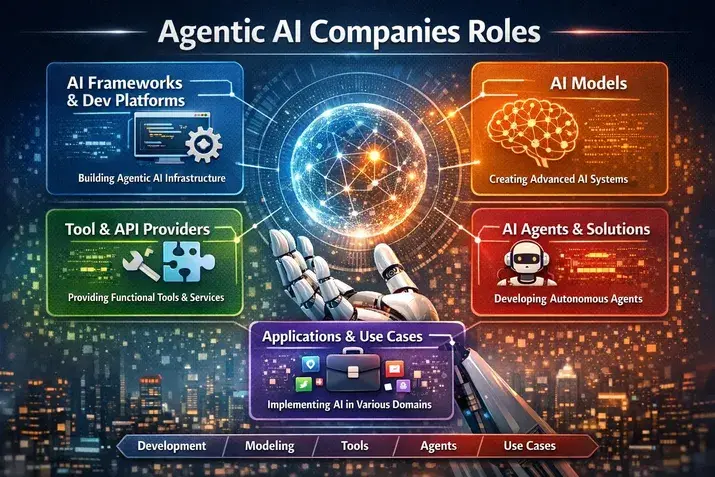
Introduction: The Strategic Shift Toward Autonomous AI Systems
The role of agentic AI companies has evolved dramatically as we move through 2026, transforming from experimental technology providers into essential strategic partners for enterprise transformation. Unlike traditional AI vendors that simply provide tools or models, agentic AI companies role extends far beyond software delivery—they’re architecting entire autonomous digital workforces that can reason, plan, and execute complex business tasks with minimal human intervention. According to Gartner’s latest predictions, over 40% of enterprise applications will embed role-specific AI agents by the end of 2026, marking a fundamental shift from passive AI assistants to proactive, goal-oriented systems.
This transformation represents more than incremental improvement in automation technology. The agentic AI companies role in today’s market involves orchestrating multi-agent systems that can break down complex business challenges into executable sub-tasks, coordinate across different software platforms, and learn from outcomes to improve performance continuously. Organizations worldwide are discovering that the companies providing these autonomous systems aren’t just technology vendors—they’re strategic enablers of competitive advantage. From Fortune 500 enterprises to mid-market companies, businesses are partnering with specialized agentic AI firms to unlock productivity gains, reduce operational costs, and solve problems that traditional automation simply couldn’t address.
Understanding Agentic AI: Beyond Traditional Automation
What Makes Agentic AI Different?
Agentic AI represents a paradigm shift from “copilot” systems that assist humans to “agent” systems that autonomously accomplish goals. Traditional AI responds to prompts and provides recommendations, but agentic systems can sense their environment, make decisions, take actions using various tools, and adapt strategies based on feedback—all without constant human supervision.
The key distinguishing characteristics include:
Autonomous Decision-Making:
- Agents evaluate situations and choose appropriate actions independently
- Systems can handle unexpected scenarios without predefined scripts
- Decision-making happens in real-time based on current context
Goal-Oriented Behavior:
- Agents work toward defined business objectives rather than just completing single tasks
- Systems can decompose complex goals into manageable sub-tasks
- Progress is measured against intended outcomes, not just task completion
Tool Usage and Integration:
- Agents can access and utilize multiple software platforms, APIs, and databases
- Systems navigate enterprise applications just as human employees would
- Integration happens at the workflow level, not just data exchange
Continuous Learning:
- Performance improves over time through experience and feedback
- Systems adapt to changing business conditions and requirements
- Error correction becomes increasingly sophisticated with usage
The Generative AI vs. Agentic AI Distinction
While generative AI excels at creating content—text, images, code—agentic AI focuses on doing tasks, solving problems, and executing strategies. Generative AI says “here’s what you asked for,” while agentic AI says “I’ve accomplished your objective.” This distinction fundamentally changes how businesses approach AI implementation and explains why specialized agentic AI companies have emerged as distinct from traditional AI vendors.
The Strategic Role of Agentic AI Companies in Enterprise Transformation
From Technology Vendors to Transformation Partners
The agentic AI companies role in 2026 has expanded far beyond providing software licenses or cloud-based models. Leading firms in this space function as comprehensive transformation partners, offering:
Strategic Consultation:
- Assessing organizational readiness for autonomous AI deployment
- Identifying high-value use cases with measurable ROI potential
- Designing multi-year roadmaps for scaling agentic capabilities
- Advising on change management and organizational structure
Technical Architecture:
- Designing multi-agent orchestration systems tailored to business processes
- Ensuring seamless integration with existing enterprise software ecosystems
- Building governance frameworks for safe autonomous operation
- Establishing security protocols that meet regulatory requirements
Implementation and Operationalization:
- Moving beyond proof-of-concept to production-ready deployments
- Training internal teams to work effectively alongside AI agents
- Providing ongoing monitoring, optimization, and support
- Scaling successful pilots across entire organizations
Key Capabilities Leading Companies Provide
Top-tier agentic AI companies role encompasses several critical capabilities that distinguish market leaders:
Multi-Agent Orchestration: Leading providers like Aisera, Straive, and Kore.ai excel at coordinating specialized agents that work together to resolve complex enterprise requests. Rather than deploying a single monolithic AI, these companies create teams of focused agents—each handling specific domains like IT, HR, finance, or customer support—that collaborate seamlessly.
Enterprise Integration Expertise: Companies such as ServiceNow (with Moveworks) and Microsoft (through Azure AI Studio) have deep expertise in connecting agentic systems with existing enterprise platforms. This integration strength ensures agents work smoothly with CRM systems, ERPs, communication tools, and legacy applications without requiring wholesale technology replacement.
Governance and Compliance: Firms operating in regulated industries—including Kanerika for finance and healthcare, and IBM with its watsonx platform—provide robust governance frameworks. These include audit trails, explainable AI features, role-based access controls, and compliance with GDPR, HIPAA, and SOC 2 standards.
Domain-Specific Solutions: Rather than offering generic AI agents, leading companies develop specialized solutions for particular industries or functions. For example:
- Cursor focuses on developer workflows and coding assistance
- Writer specializes in content creation and knowledge management
- Amelia concentrates on conversational AI for customer service
- SAP Joule embeds agents directly into ERP and finance operations
Top Agentic AI Companies Leading the Market in 2026
Enterprise-Scale Providers
Aisera: Recognized as a Gartner Visionary and Forrester Leader, Aisera delivers a sophisticated “System of Agents” architecture enabling specialized agents to collaborate across IT, HR, finance, and customer support domains. The company’s multi-agent orchestration platform handles complex enterprise requests autonomously, with proven success in organizations managing thousands of employees.
Straive: Operating at massive scale with proven operational clarity, Straive has been identified as a top partner for enterprises confidently adopting agentic systems. The company emphasizes moving beyond controlled pilots to reliable performance in everyday operations, with strong integration capabilities across enterprise tools and data systems.
Microsoft: Through Azure AI Studio and Copilot integrations, Microsoft embeds agentic capabilities directly within enterprise workflows. The company’s strength lies in security, governance, and compatibility with legacy tools, making it a natural choice for organizations already invested in the Microsoft ecosystem. Azure AI provides cloud-based agent builder services for developers creating custom autonomous systems.
OpenAI: While primarily known for foundational AI models, OpenAI’s technology powers numerous agentic applications across the industry. The company’s models serve as the reasoning engine for many specialized agents, particularly with recent advances like ChatGPT Operator that can perform multi-step research and task execution on the internet.
IBM: With decades of AI experience, IBM’s watsonx platform provides pre-built components, orchestration tools, and governance frameworks designed for large, complex enterprise environments. The company takes a strategy-first, enterprise-focused approach, emphasizing autonomous reasoning, retrieval-augmented workflows, and domain-specific agent architectures.
Specialized Solution Providers
Moveworks (ServiceNow): Integrates agentic AI deeply with the ServiceNow platform, specializing in enterprise IT automation. The company’s agents can handle service desk requests, system provisioning, and knowledge management with minimal human intervention, making it particularly strong for IT operations.
NVIDIA: While primarily known for GPUs, NVIDIA plays a crucial infrastructure role, providing the computing power and software frameworks (CUDA, Omniverse) that enable development, testing, and deployment of AI agents across industries including autonomous vehicles, robotics, and gaming.
Cognition Labs: An emerging player focusing on AI agents for software development workflows. The company builds autonomous systems that can write, test, and debug code, representing the cutting edge of agentic AI applied to engineering tasks.
CrewAI: Offers a multi-agent platform facilitating creation and deployment of AI-driven workflows. With integration-ready partnerships including Anthropic, HubSpot, Oracle, PwC, and KPMG, CrewAI empowers businesses to leverage AI agents for automating tasks with strong scalability improvements.
Explore comprehensive insights on how agentic AI companies are shaping the future through autonomous systems that are transforming business operations across industries.
Development and Implementation Partners
DevCom: A full-service software partner with 25+ years of experience, DevCom specializes in custom agentic AI solutions for SMBs. The company builds tailored autonomous systems for data analysis, content management, customer service, and workflow automation, with expertise in multi-agent architectures and continuous performance optimization.
Rootstrap: California-based software agency known for integrating multi-agent workflows into digital products through flexible, senior-level engineering support. The company focuses on helping businesses embed agentic capabilities into existing applications rather than building entirely new systems.
Entrans: US-Indian development company building autonomous agents and large, interconnected automation systems for growth-oriented businesses. Entrans specializes in full-lifecycle development and integration in legacy environments with in-depth testing protocols.
Real-World Applications: How Companies Deploy Agentic AI
Enterprise IT and Operations
Organizations are deploying agentic AI to transform IT service management, with agents handling:
Service Desk Automation:
- Autonomous ticket triage and routing based on complexity and urgency
- Automatic resolution of common issues without human intervention
- Intelligent escalation when specialized expertise is required
- 24/7 availability eliminating wait times for basic support
System Monitoring and Maintenance:
- Continuous monitoring of infrastructure health and performance
- Predictive maintenance identifying issues before failures occur
- Automated remediation of detected problems
- Security threat detection and response
Real-World Impact: Telus reported that more than 57,000 employees regularly use AI agents, saving 40 minutes per interaction. This translates to massive productivity gains across the organization while improving employee satisfaction by eliminating frustrating manual tasks.
Customer Experience and Support
The customer service industry is experiencing fundamental transformation through agentic AI:
Hyperpersonalized Service:
- Agents provide “concierge-style” support understanding full customer context
- Systems anticipate needs based on behavior patterns and history
- Personalization happens in real-time during interactions
- Consistency maintained across all communication channels
Complex Issue Resolution:
- Agents coordinate across multiple backend systems to resolve issues
- Systems can access customer data, order history, and product information simultaneously
- Multi-step problems handled without customer needing to explain repeatedly
- Escalation to humans only when truly necessary
Business Results: One services organization digitized every process and consolidated data into a single AI assistant spanning all channels, achieving double-digit improvements in every metric related to cost and customer satisfaction.
Financial Services and Banking
Financial institutions leverage agentic AI for:
Risk Management:
- Autonomous analysis of transaction patterns for fraud detection
- Real-time risk assessment for lending decisions
- Portfolio monitoring and rebalancing recommendations
- Regulatory compliance checking across operations
Process Automation:
- Automated processing of loan applications
- Invoice and payment reconciliation
- Financial reporting generation
- Customer onboarding and KYC verification
Healthcare and Life Sciences
Medical providers use agentic AI to:
Patient Care Coordination:
- Autonomous scheduling optimization
- Electronic health record management
- Treatment plan monitoring and adjustments
- Medication management and reminders
Clinical Operations:
- Medical examination assistance
- Diagnostic support systems
- Drug discovery acceleration
- Clinical trial participant matching
Compliance Note: Healthcare organizations work with specialized agentic AI companies that understand handling of personally identifiable information (PII) and protected health information (PHI) under HIPAA regulations.
Manufacturing and Supply Chain
Industrial companies deploy agents for:
Predictive Maintenance:
- Analysis of IoT sensor data from thousands of devices
- Early detection of equipment failure signals
- Automated maintenance scheduling optimization
- Quality control defect identification
Supply Chain Optimization:
- Inventory level management across warehouses
- Demand forecasting and production planning
- Route optimization for delivery fleets
- Real-time adjustment to disruptions
Selecting the Right Agentic AI Partner for Your Organization
Critical Evaluation Criteria
When assessing potential agentic AI companies role in your transformation, consider these essential factors:
Proven Production Success: Look beyond impressive demos and pilot projects. The best partners demonstrate success in real-world, production environments at scale. Ask for:
- Case studies from similar industries and company sizes
- Customer references willing to discuss actual results
- Metrics on agent reliability and uptime in production
- Evidence of successful scaling from pilot to enterprise-wide deployment
Integration Capabilities: Seamless integration with existing enterprise systems is non-negotiable. Evaluate:
- Pre-built connectors for your critical business applications
- API flexibility for custom integrations
- Support for both cloud and on-premises environments
- Track record with legacy system integration
Governance and Security: As agents gain autonomy, robust governance becomes critical:
- Audit trail capabilities tracking all agent decisions and actions
- Role-based access controls limiting agent permissions
- Explainable AI features making decision logic transparent
- Compliance certifications relevant to your industry (GDPR, HIPAA, SOC 2)
Scalability Architecture: Systems must grow with your needs:
- Ability to add new agents without rebuilding infrastructure
- Performance under increasing workload
- Multi-agent coordination at scale
- Cloud infrastructure supporting global operations
ROI and Business Alignment: Partnerships should deliver measurable business value:
- Clear methodology for calculating expected ROI
- Alignment of agent capabilities with strategic business goals
- Realistic timelines for value realization
- Ongoing optimization support post-implementation
Red Flags to Avoid
Beware of vendors exhibiting these warning signs:
“Agent Washing”: Gartner warns that of thousands of claimed agentic AI vendors, only approximately 130 offer legitimate agent technology. Many companies rebrand existing automation tools or chatbots as “AI agents” without genuine agentic capabilities.
Verification Tips:
- Ask for detailed technical explanations of autonomous decision-making
- Request demonstrations of agents handling unexpected scenarios
- Verify that systems can use tools and adapt strategies independently
- Check if “agents” require constant human prompting
Overpromising and Unrealistic Timelines: Be cautious of vendors promising:
- Immediate, massive cost reductions without transition period
- Complete automation of complex processes within weeks
- Zero change management or employee training required
- Perfect accuracy and no need for human oversight
Lack of Industry Expertise: Generic solutions rarely address industry-specific challenges effectively. Prefer partners who:
- Demonstrate deep understanding of your industry’s unique requirements
- Provide relevant case studies and references
- Employ experts familiar with your regulatory environment
- Offer domain-specific agent architectures
Implementation Best Practices: Maximizing Success with Agentic AI
Phase 1: Assessment and Strategy (Weeks 1-4)
Define Clear Objectives: Begin with specific, measurable business outcomes rather than technology goals. Examples include:
- Reduce customer service response time by 50%
- Automate 70% of routine IT service desk tickets
- Decrease invoice processing time from days to hours
- Improve employee onboarding efficiency by 60%
Identify High-Value Use Cases: Work with your agentic AI partner to map business processes and identify opportunities where agents can deliver maximum impact. Prioritize based on:
- Frequency of task occurrence
- Time currently consumed by manual execution
- Error rates in existing processes
- Employee frustration levels
- Customer impact potential
Assess Organizational Readiness: Evaluate critical success factors including:
- Data quality and accessibility
- Existing system integration capabilities
- Leadership commitment and sponsorship
- Employee willingness to adopt new technologies
- Change management resources available
Phase 2: Pilot Deployment (Weeks 5-12)
Start with Controlled Scope: Successful agentic AI implementations begin small and scale progressively:
- Choose one well-defined process with measurable outcomes
- Ensure adequate data availability and quality
- Select use case where failure won’t cause major disruptions
- Pick process that, if successful, can scale to other areas
Implement Human-on-the-Loop: Rather than fully autonomous operation immediately, establish oversight mechanisms:
- Human review of agent decisions during initial deployment
- Clear escalation paths when agents encounter uncertainty
- Regular performance monitoring and adjustment
- Gradual reduction of oversight as confidence builds
Measure and Learn: Track predefined success metrics rigorously:
- Time savings per task
- Error rate reduction
- User satisfaction scores
- Cost per transaction
- Agent utilization rates
Document Lessons: Create institutional knowledge by recording:
- Challenges encountered and solutions implemented
- Unexpected agent behaviors and corrective actions
- User feedback and feature requests
- Best practices emerging from pilot experience
Phase 3: Scaling and Optimization (Months 4-12)
Expand Systematically: Apply learnings from pilots to new implementations:
- Develop templates and frameworks accelerating deployment
- Build library of reusable agent components
- Create communities of practice for knowledge sharing
- Establish centers of excellence for agentic AI
Implement Multi-Agent Systems: As confidence grows, deploy coordinated agent teams:
- Identify processes benefiting from specialized agent collaboration
- Design orchestration layers coordinating multiple agents
- Establish protocols for agent-to-agent communication
- Create monitoring dashboards showing entire system performance
Continuous Optimization: Mature implementations require ongoing improvement:
- Regular review of agent performance metrics
- A/B testing of different agent configurations
- Updating agent knowledge bases with new information
- Retraining models based on changing business conditions
The Future: What’s Next for Agentic AI Companies
Emerging Trends Shaping 2026 and Beyond
Industry-Specific Agents: The shift from generic to specialized solutions accelerates as companies recognize that domain expertise matters as much as technical capability. Learn more about IBM’s perspective on AI tech trends including the evolution toward industry-specific agentic systems.
Democratization Through Small Language Models: AT&T and other industry leaders predict Small Language Models (SLMs) will gain significant enterprise traction, making specialized AI accessible at a fraction of large language model costs. Fine-tuned SLMs trained on focused data provide exceptional performance for specific tasks while delivering faster processing and dramatically reduced costs.
Agent-Driven Commerce: An emerging capability involves agents autonomously requesting and paying for services. While still early stage, this addresses a fundamental limitation—autonomy that stops at payment creates friction and reduces agent effectiveness. Various solutions are emerging to enable agent-driven commerce, particularly for applications using multiple models across different pricing tiers.
Cross-Platform Interoperability: Major technology companies like Salesforce and Google Cloud are building agents using the Agent2Agent (A2A) protocol, creating an open, interoperable foundation for agentic enterprises. This interoperability prevents vendor lock-in and enables organizations to build best-of-breed agent ecosystems rather than relying on single-vendor solutions.
Preparing for the Agentic Future
Organizations that will thrive in the age of agentic AI are taking these steps now:
Building AI Literacy: Ensuring employees at all levels understand AI capabilities, limitations, and best practices for working alongside autonomous systems.
Establishing Governance Frameworks: Creating clear policies defining which agents can do what, with which data, and under whose supervision. Corporate boards are beginning to ask the same questions about AI agents that they ask about human employees.
Investing in Data Excellence: Recognizing that agent effectiveness depends fundamentally on data quality, accessibility, and governance. Organizations are consolidating data sources, establishing quality standards, and implementing clear governance policies.
Fostering Innovation Culture: Encouraging experimentation and learning from both successes and failures. Organizations understand that becoming agentic requires cultural transformation, not just technology adoption.
Frequently Asked Questions About Agentic AI Companies
What exactly do agentic AI companies provide?
Agentic AI companies deliver autonomous systems capable of sensing, reasoning, planning, and acting to accomplish business goals with minimal human intervention. Beyond software, they provide strategic consulting, technical architecture design, integration services, governance frameworks, and ongoing optimization support. Leading firms act as transformation partners rather than simply technology vendors.
How do I choose between different agentic AI companies?
Selection should prioritize proven production success over impressive demos, seamless integration with your existing systems, robust governance and security capabilities, and clear pathways to measurable ROI. Industry-specific expertise often proves more valuable than generic solutions. Verify that vendors offer legitimate agentic capabilities rather than rebranded chatbots or traditional automation tools.
What is the typical timeline for implementing agentic AI?
Implementation timelines vary based on scope and complexity. Pilot projects typically take 8-12 weeks from planning through deployment. Moving to production-ready systems at scale generally requires 6-12 months. Full enterprise-wide transformation spanning multiple departments and processes often takes 18-24 months. However, organizations begin seeing value from initial pilots within the first quarter.
How much does working with agentic AI companies cost?
Costs vary dramatically based on scope, industry, and vendor. Pilot projects with established platforms might range from $50,000-$200,000. Enterprise-wide implementations can range from $500,000 to several million dollars depending on complexity, customization requirements, and scale. However, total cost of ownership should consider savings from automation, error reduction, and productivity gains, which often deliver positive ROI within 12-18 months.
What industries benefit most from agentic AI?
While virtually every industry can benefit, early adopters with significant success include financial services (fraud detection, risk assessment, compliance), healthcare (patient care coordination, diagnostic support, clinical operations), manufacturing (predictive maintenance, quality control, supply chain optimization), customer service (automated support, personalized experiences), and IT operations (service desk automation, system monitoring). Regulated industries particularly benefit from specialized providers understanding compliance requirements.
Will agentic AI replace human workers?
Rather than wholesale replacement, agentic AI creates hybrid workforces where agents handle routine, repetitive, rule-based tasks while humans focus on complex decisions requiring empathy, creativity, strategic thinking, and judgment. Organizations implementing agentic AI successfully report that employees shift to higher-value work rather than being eliminated. The agentic AI companies role includes helping organizations manage this workforce transition effectively through change management, training, and redefining job responsibilities.
Conclusion: Embracing the Agentic Transformation
The agentic AI companies role in enterprise transformation extends far beyond providing software tools or cloud-based models—they’re strategic partners enabling organizations to fundamentally reimagine how work gets done. As we progress through 2026, the companies successfully deploying autonomous AI agents aren’t just achieving incremental efficiency gains; they’re establishing competitive advantages that will define industry leadership for the next decade. From Aisera’s multi-agent orchestration to Microsoft’s enterprise-grade Azure platforms, from IBM’s governance-focused watsonx to specialized providers like Cursor and Writer, the ecosystem of agentic AI companies offers solutions for virtually every industry and use case.
However, success requires more than selecting the right vendor or purchasing sophisticated software. Organizations must approach agentic AI as a holistic transformation involving strategy, technology, people, and culture. The most successful implementations begin with clear business objectives, prioritize high-value use cases, invest in data quality and governance, establish appropriate oversight mechanisms, and foster cultures where humans and AI agents collaborate as partners. By working with the right agentic AI companies and following proven implementation practices, organizations can unlock the tremendous potential of autonomous systems—reducing costs, improving customer experiences, empowering employees, and solving problems that traditional automation simply couldn’t address. The future belongs to organizations that embrace this transformation now, building the foundations for success in an increasingly agentic world.
External Resources and Citations
For deeper insights into the agentic AI landscape and industry trends:
- IBM Think: AI Tech Trends and Predictions 2026 – Comprehensive analysis from one of the leading enterprise AI providers covering agentic systems, market evolution, and implementation strategies
- Aisera Blog: Top Agentic AI Companies and Tools – Detailed vendor analysis and enterprise implementation guidance from a recognized Gartner Visionary in agentic AI
Social Media Hashtags: #AgenticAI #AIAgents #EnterpriseAI #BusinessAutomation #AITransformation #AutonomousAI #MultiAgentSystems #DigitalTransformation #AICompanies #TechTrends2026 #ArtificialIntelligence #FutureOfWork #AIInnovation #EnterpriseAutomation #AIStrategy
Schema Markup (JSON-LD):
{
  "@context": "https://schema.org",
  "@type": "Article",
  "headline": "Agentic AI Companies Role: How Leading Firms Are Revolutionizing Enterprise Automation in 2026",
  "description": "Comprehensive guide to how agentic AI companies are transforming business operations through autonomous systems, multi-agent orchestration, and strategic partnership.",
  "image": "https://rankrise1.com/images/agentic-ai-companies-role-2026.jpg",
  "author": {
    "@type": "Organization",
    "name": "RankRise1",
    "url": "https://rankrise1.com"
  },
  "publisher": {
    "@type": "Organization",
    "name": "RankRise1",
    "logo": {
      "@type": "ImageObject",
      "url": "https://rankrise1.com/logo.png"
    }
  },
  "datePublished": "2026-01-09",
  "dateModified": "2026-01-09",
  "mainEntityOfPage": {
    "@type": "WebPage",
    "@id": "https://rankrise1.com/agentic-ai-companies-role"
  },
  "about": {
    "@type": "Thing",
    "name": "Agentic AI Companies",
    "description": "Organizations providing autonomous AI agent systems and enterprise transformation services"
  },
  "keywords": "agentic AI companies role, AI agents, autonomous AI, enterprise automation, multi-agent systems, business transformation"
}
{
  "@context": "https://schema.org",
  "@type": "FAQPage",
  "mainEntity": [
    {
      "@type": "Question",
      "name": "What exactly do agentic AI companies provide?",
      "acceptedAnswer": {
        "@type": "Answer",
        "text": "Agentic AI companies deliver autonomous systems capable of sensing, reasoning, planning, and acting to accomplish business goals with minimal human intervention. Beyond software, they provide strategic consulting, technical architecture design, integration services, governance frameworks, and ongoing optimization support."
      }
    },
    {
      "@type": "Question",
      "name": "How do I choose between different agentic AI companies?",
      "acceptedAnswer": {
        "@type": "Answer",
        "text": "Selection should prioritize proven production success over impressive demos, seamless integration with your existing systems, robust governance and security capabilities, and clear pathways to measurable ROI. Industry-specific expertise often proves more valuable than generic solutions."
      }
    },
    {
      "@type": "Question",
      "name": "What is the typical timeline for implementing agentic AI?",
      "acceptedAnswer": {
        "@type": "Answer",
        "text": "Pilot projects typically take 8-12 weeks from planning through deployment. Moving to production-ready systems at scale generally requires 6-12 months. Full enterprise-wide transformation spanning multiple departments often takes 18-24 months."
      }
    },
    {
      "@type": "Question",
      "name": "Will agentic AI replace human workers?",
      "acceptedAnswer": {
        "@type": "Answer",
        "text": "Rather than wholesale replacement, agentic AI creates hybrid workforces where agents handle routine tasks while humans focus on complex decisions requiring empathy, creativity, and judgment. Organizations implementing agentic AI successfully report that employees shift to higher-value work."
      }
    }
  ]
}