

Agentic AI Transforms Enterprise Workflows: The Ultimate Guide to Business Automation in 2025
Introduction
The business landscape is experiencing a seismic shift as artificial intelligence evolves from simple task automation to sophisticated, autonomous decision-making systems. Agentic AI transforms enterprise workflows by introducing intelligent agents that can plan, execute, and adapt to complex business processes without constant human supervision. Unlike traditional automation tools that follow rigid scripts, these AI agents understand context, learn from patterns, and make informed decisions that align with organizational goals. Companies like JPMorgan Chase and Siemens are already witnessing unprecedented efficiency gains, with some reporting up to 40% reduction in operational costs and 60% faster project completion times.
This transformation isn’t just about replacing manual tasks—it’s about reimagining how businesses operate in an increasingly digital-first world. As enterprises grapple with mounting data volumes, complex customer expectations, and fierce competition, Agentic AI transforms enterprise workflows into streamlined, intelligent systems that respond in real-time to changing conditions. The technology combines machine learning, natural language processing, and autonomous reasoning to create digital workers that collaborate seamlessly with human teams, handle exceptions gracefully, and continuously improve their performance without requiring constant reprogramming.
Understanding Agentic AI: Beyond Traditional Automation
What Makes Agentic AI Different?
Traditional automation tools execute predefined sequences—if X happens, do Y. Agentic AI, however, operates with genuine autonomy and intelligence. These systems set their own sub-goals, plan multi-step workflows, and adapt strategies based on outcomes. According to a McKinsey report, businesses implementing agentic systems see 3.5 times higher ROI compared to traditional robotic process automation (RPA).
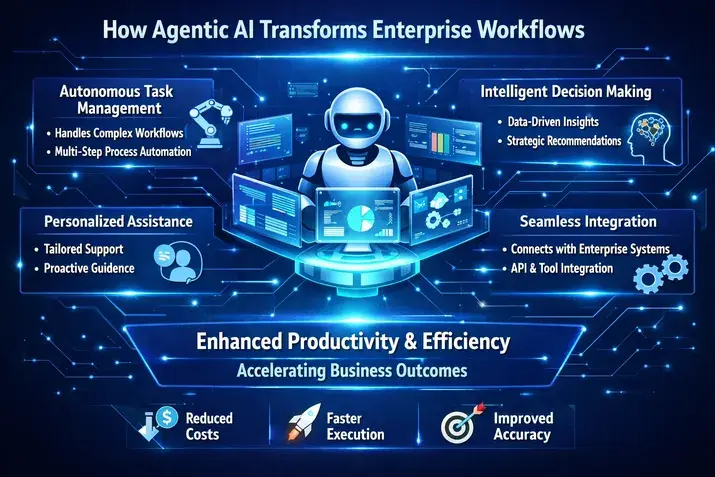
The key differentiator lies in cognitive capabilities: Agentic AI transforms enterprise workflows through reasoning abilities that mirror human decision-making. These agents can:
- Interpret ambiguous instructions and ask clarifying questions
- Prioritize tasks based on business impact and urgency
- Learn from successes and failures to optimize future actions
- Collaborate with multiple systems and stakeholders simultaneously
- Handle unexpected scenarios without human intervention
The Technology Stack Behind Agentic Systems
Modern agentic AI combines several cutting-edge technologies. Large language models provide natural language understanding, while reinforcement learning enables agents to improve through trial and error. Computer vision allows document processing and visual inspection, and knowledge graphs ensure agents maintain contextual awareness across complex workflows. This sophisticated stack enables Agentic AI transforms enterprise workflows with unprecedented sophistication.
Real-World Applications Across Industries
Customer Service Revolution
Zendesk recently deployed agentic AI that handles 78% of customer inquiries end-to-end without human escalation. These agents don’t just answer questions—they analyze customer history, predict needs, coordinate with inventory systems, process refunds, and follow up proactively. Customer satisfaction scores increased by 34% while support costs dropped by $2.1 million annually.
Financial Operations and Compliance
In finance departments, Agentic AI transforms enterprise workflows by autonomously managing invoice processing, expense approvals, and compliance checks. Deloitte’s implementation for a Fortune 500 client reduced month-end closing time from 12 days to 3 days. The agents detect anomalies, flag potential fraud, ensure regulatory compliance, and generate detailed audit trails—all while learning to improve accuracy with each transaction.
For a comprehensive understanding of enterprise implementation, explore how Agentic AI transforms enterprise workflows with detailed case studies and technical insights.
Supply Chain Optimization
Logistics companies are experiencing remarkable results. DHL’s agentic system predicts disruptions 48 hours before they occur, automatically reroutes shipments, negotiates with alternative carriers, and updates customers—all without human oversight. This proactive approach reduced delivery delays by 67% and saved an estimated $15 million in expedited shipping costs.
Human Resources and Talent Management
Agentic AI transforms enterprise workflows in HR by handling recruitment screening, scheduling interviews, conducting initial assessments, and even managing onboarding processes. IBM’s HR agent processes 10,000 candidate applications monthly, reducing time-to-hire from 42 days to 18 days while improving candidate quality scores by 28%.
Implementation Strategies for Enterprise Success
Assess Workflow Complexity and Readiness
Begin by mapping current workflows and identifying processes with high volume, clear decision rules, and measurable outcomes. According to Gartner, workflows with 70% or higher standardization achieve the fastest ROI when automated with agentic systems. Prioritize processes causing bottlenecks or requiring significant manual intervention.
Start Small, Scale Strategically
Successful implementations follow a pilot-scale-optimize cycle. Launch with one department or process, measure results meticulously, and gather user feedback before enterprise-wide deployment. Accenture’s research shows companies using phased rollouts achieve 2.3 times higher adoption rates and 40% fewer implementation issues.
Integrate with Existing Systems
Agentic AI transforms enterprise workflows most effectively when seamlessly connected to your tech stack. Ensure agents can access CRM, ERP, communication platforms, and databases through secure APIs. Microsoft’s enterprise clients report that proper integration reduces implementation time by 60% and eliminates data silos that previously hindered automation efforts.
Establish Governance and Oversight
While agents operate autonomously, human oversight remains crucial. Implement monitoring dashboards, establish escalation protocols, and create feedback loops for continuous improvement. Set clear boundaries defining when agents should escalate to humans, particularly for high-stakes decisions or sensitive customer interactions.
Measuring Success: Key Performance Indicators
Track metrics that matter: process completion time, error rates, cost per transaction, employee satisfaction, and customer experience scores. Leading organizations also monitor agent learning curves, decision accuracy, and exception handling effectiveness. The Harvard Business Review found that companies tracking comprehensive AI performance metrics achieve 56% better business outcomes than those focusing solely on cost reduction.
Overcoming Implementation Challenges
Data Quality and Accessibility
Agents require clean, accessible data to function effectively. Organizations should invest in data governance, establish single sources of truth, and implement robust data pipelines. Poor data quality accounts for 67% of agentic AI implementation failures, according to MIT research.
Change Management and Employee Adoption
Employee resistance remains a significant barrier. Successful companies frame Agentic AI transforms enterprise workflows as augmentation rather than replacement, providing training that helps employees work alongside AI agents effectively. For additional resources on AI implementation strategies, the Forbes Technology Council offers valuable insights from industry leaders.
Security and Compliance Considerations
Implement zero-trust architectures, encrypt agent communications, and ensure compliance with data protection regulations. Regular security audits and penetration testing should validate agent behaviors don’t introduce vulnerabilities. The MIT Technology Review frequently publishes research on AI security best practices worth consulting.
Future Trends: What’s Next for Agentic AI
The next evolution involves multi-agent collaboration, where specialized AI agents negotiate, cooperate, and coordinate complex projects autonomously. Researchers at Stanford predict that by 2027, enterprise environments will commonly feature 10-15 specialized agents working in concert, managed by orchestrator agents that allocate resources and resolve conflicts.
Emotional intelligence capabilities are advancing rapidly. Future agents will detect user frustration, adapt communication styles, and build rapport—making interactions indistinguishable from human colleagues. Integration with augmented reality will enable agents to guide physical tasks, while quantum computing will exponentially expand their problem-solving capabilities.
Frequently Asked Questions
What is the difference between Agentic AI and traditional automation? Traditional automation follows predefined rules and scripts, while Agentic AI makes autonomous decisions, adapts to new situations, and learns from experience. Agentic systems can handle exceptions, plan multi-step workflows, and operate with minimal human oversight.
How much does Agentic AI implementation typically cost? Implementation costs vary widely based on complexity and scale, ranging from $50,000 for small deployments to several million for enterprise-wide transformations. However, ROI typically materializes within 12-18 months, with average cost reductions of 30-40%.
Will Agentic AI replace human workers? Rather than replacement, Agentic AI augments human capabilities by handling repetitive, high-volume tasks. This allows employees to focus on strategic thinking, creativity, and complex problem-solving. Organizations typically redeploy rather than reduce staff.
How secure is Agentic AI for handling sensitive business data? When properly implemented with encryption, access controls, and monitoring, Agentic AI systems meet or exceed traditional security standards. Regular audits, compliance certifications, and zero-trust architectures ensure data protection.
What industries benefit most from Agentic AI workflows? Financial services, healthcare, logistics, customer service, and manufacturing see the strongest benefits. However, any industry with high-volume repetitive processes, complex decision-making, or data-intensive operations can achieve significant improvements.
How long does implementation take? Pilot implementations typically require 2-4 months, while full enterprise deployment ranges from 6-18 months depending on complexity, integration requirements, and organizational readiness. Phased approaches reduce risk and accelerate time-to-value.
Conclusion
The evidence is overwhelming: Agentic AI transforms enterprise workflows in ways that fundamentally reshape competitive dynamics across industries. Organizations embracing this technology aren’t simply automating tasks—they’re building intelligent, adaptive systems that respond to complexity with human-like reasoning and machine-scale efficiency. The data speaks clearly: 40% cost reductions, 60% faster cycle times, and significantly improved employee and customer satisfaction. These aren’t incremental improvements; they represent a paradigm shift in how enterprises operate, compete, and deliver value in an increasingly digital economy.
The window of opportunity is narrowing as early adopters establish commanding leads over competitors still relying on traditional approaches. Success requires more than technology deployment—it demands cultural transformation, strategic vision, and commitment to continuous learning. Companies that view Agentic AI transforms enterprise workflows as a journey rather than a destination position themselves to thrive in an AI-first business landscape. The question isn’t whether to implement agentic systems, but how quickly your organization can adapt, learn, and scale these capabilities to maintain relevance in a rapidly evolving marketplace. The future belongs to enterprises that recognize AI agents not as tools, but as collaborative partners in achieving unprecedented business outcomes.
#AgenticAI #EnterpriseAutomation #AITransformation #DigitalWorkflows #BusinessInnovation #ArtificialIntelligence #WorkflowOptimization #EnterpriseTech #AIImplementation #FutureOfWork #BusinessAutomation #IntelligentSystems #DigitalTransformation #AIStrategy #EnterpriseSolutions